Terence Tao's ICM 2026 public lecture 'Mathematics in the age of AI' calls a crisis in the foundations of mathematical values
On 24 Jul 2026, at the International Congress of Mathematicians in Philadelphia, Terence Tao gave the public lecture "Mathematics in the age of AI". He argued that mathematics is entering a "crisis in the foundations of mathematical values and practices", comparable to the 1900–1930 foundations crisis. Setting aside the capability debate, he asked what the community's goals should be if strong AI capability arrives. An essay version is arXiv 2608.16753.
Key facts
- Venue: ICM 2026 public lecture, Pennsylvania Convention Center, Philadelphia, 24 Jul 2026 (7:15 pm)
- Frames an 'AI Capability Conjecture' (weak vs strong forms) and conditions on it being true, then asks the orthogonal 'Goals and Values Question'
- Uses problem-solving as a case study: from 'solve as many unsolved problems as possible' to results that are verified, clearly communicated, digested and incorporated into the definitive theory
- Recommendation reported by press: results that cannot be shown correct and properly attributed, or explained by their authors, should not be published; disclose tool use
- Slide footnote: 'All em-dashes in these slides were human-generated.'
- Essay: arXiv 2608.16753 (17 Aug 2026, 12 pages, submitted to the ICM 2026 Proceedings)
- Tao also published an AI-collated summary of his AI views and an AI-conducted 'hard hitting' interview of himself
Science result
- Field
- mathematics / meta-mathematics / research culture
- Problem
- How the mathematical community should respond to AI tools that can do research-level mathematics
- Result
- Programmatic lecture and essay reframing the debate from AI capability to the community's goals and values.
- AI system
- n/a
- Human role
- Human-led
- Verification
- Public lecture; essay submitted to ICM Proceedings
- Status
- confirmed
What happened
Tao's public lecture at the quadrennial ICM compared the present moment to the early-20th-century crisis in foundations. That crisis ended with a rigorous, standardized framework. Tao said the community now needs to codify its values in the same way. He deliberately did not argue about which AI capabilities are real. He treated a "reasonably strong" capability conjecture as a working hypothesis and asked what mathematicians actually want. Press described the lecture as more foreboding than his earlier comments.
Why it matters
It was the most prominent framing of AI-and-mathematics at the field's main quadrennial event. It came just before the wave of AI results (Astra's ten advances, Navier–Stokes) and the community statements that followed (Fields Medallists' letter, Palomar, SAIR).
Changelog
- 2026-09-29: created (lead from data/leads.md)
Videos (1)
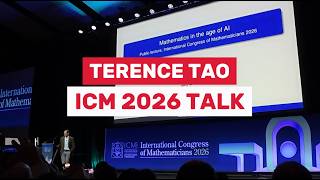
Terence Tao: "Mathematics in the Age of AI" (ICM 2026)
Alvaro Lozano-Robledo · 2026-07-27 · communityDescription by Gemini, which watched the video:
Summary
Terence Tao delivers a public lecture titled "Mathematics in the age of AI" at the International Congress of Mathematicians 2026 (ICM 2026) on July 24, 2026. He evaluates the impact of advancing AI systems on mathematical research, comparing current shifts to historical foundational crises and warning that optimizing purely for automated problem-solving risks breaking the consensus-building, human understanding, and exposition that underpin mathematics.
What is shown
- [00:00] Title slide introducing Terence Tao's ICM 2026 public lecture on July 24, 2026.
- [00:46] Historical overview slide tracing the crisis in mathematical foundations (c. 1900–1930) and the formalization of naive concepts (sets, numbers, limits).
- [03:01] Formalization of the "AI Capability Conjecture (template)" framing AI capabilities in terms of expense, supervision, domain, and success rates.
- [04:40] Presentation of the "First Proof" benchmark evaluation slide assessing four frontier AI harnesses against novel research-level problems.
- [05:25] Analysis slides outlining the "Goals and Values Question" and examining Goodhart's law applied to mathematical goals.
- [08:56] Diagram showing how AI optimization causes divergent pressures on core mathematical goals (theory building, Erdős problems, Olympiads, teaching, community).
- [11:11] Workflow diagram illustrating the pipeline of mathematics: open problems $\to$ proof generation $\to$ unverified solutions $\to$ proof verification $\to$ verified solutions $\to$ proof exposition $\to$ well-written solutions.
- [12:41] Personal artifact: Tao shows heavily annotated scanned pages of a 1991 paper by Jean Bourgain from his graduate student days, explaining how struggling through dense proofs is essential to learning.
- [14:16] Slide citing William Thurston's 1994 paper "On proof and progress in mathematics".
- [17:50] Slide detailing the concept of "proof indigestion" and the shift from an era of "proof scarcity" to "proof abundance," drawing an analogy to dietary health and food abundance.
- [19:43] Recommendations slide urging the math community to tightly restrict AI in foundational education/training while developing new workflows for research.
Claims & numbers
- The presenter notes that for the "First Proof" benchmark, the second batch was tested under controlled scientific conditions against four AI harnesses on May 28, 2026, using ten novel research problems; seven of the ten problems were solved at a publication-level quality by at least one team, with compute costs ranging from $10 to $1,000 USD per problem.
- Tao notes that problem repositories such as erdosproblems.com already receive dozens of AI-generated proof submissions where submitters often cannot personally verify or explain the arguments.
- Tao argues that mathematical infrastructure faces "proof indigestion" under proof abundance, where generation and verification outpace human refereeing, exposition, and canonicalization.
Notable quotes
- [14:30] "We are not trying to meet some abstract production quota of definitions, theorems, and proofs. The measure of our success is whether what we do enables people to understand and think more clearly and effectively about math." (quoting William Thurston)
- [15:28] "Community acceptance of a result, by its nature, is slow and human. It can be encouraged with good exposition and careful writing. But it is ultimately an external process that cannot be optimized purely by the authors and their AI tools."
- [18:07] "In short, we will transition from an era of proof scarcity to an era of proof abundance."
Assessment
This is authentic footage of Terence Tao's live public lecture delivered at ICM 2026, captured from the audience. The talk contains no fabricated claims or product hype, focusing on meta-mathematical methodology, community governance, and philosophical reflections on AI integration into mathematical research.
Described by gemini-3.8-flash on 2026-09-29 from the video's audio and frames.
Related events
- Fields Medallists' open letter 'A Severe Misalignment of AI in Mathematics' criticises labs' race for famous problems ★★★
- Leiden Declaration on Artificial Intelligence and Mathematics sets community norms for AI in maths (4,000+ signatories) ★★★
- Palomar launches: a registry of Lean-verified mathematics to curb misrepresented AI proof claims ★★★
Sources (8)
- officialTao: slides 'Mathematics in the age of AI' (PDF)
- paperarXiv 2608.16753: Mathematics in the age of AI (essay)
- officialTao on Mathstodon: slides uploaded, AI-made summary and interview
- officialTerence Tao on AI in mathematics (and beyond), AI-collated summary
- officialTao: AI 'interview' on his AI views
- pressScientific American: If AI can do math, what's the point of mathematicians?
- pressSimons Foundation: Watch: Terence Tao on AI and why we do math
- videoYouTube recording (uploaded by Alvaro Lozano-Robledo)
id: 2026-07-24-tao-icm-mathematics-in-the-age-of-ai · updated 2026-09-29 · open in the interactive timeline