Skild AI's S1 learns soccer through 140+ years of simulated self-play and transfers to a real humanoid
On Sept 23, 2026 Skild AI showed "Physical Self-Play": it post-trained its S1 robot foundation model to play soccer only by playing past versions of itself in NVIDIA Isaac Sim, with scoring as the only reward, over 140+ simulated years. Dribbling, shielding, tackling and getting up after falls emerged without specific rewards, and the policy transferred to a real Unitree G1 humanoid playing against humans.
Key facts
- Announced ~Sept 23, 2026 (some outlets say Sept 22)
- Self-play against past versions of itself in NVIDIA Isaac Sim; the only reward was 'score'
- 140+ years of simulated play
- Emergent skills: dribbling, shielding, tackling, fall recovery; early passing in four-agent games
- Transferred to a real Unitree G1 humanoid, playing against humans and robots
- Compute, wall-clock time and the sim-to-real recipe were not disclosed; a paper was promised
- CEO Deepak Pathak: 'This method scales, and we will scale it.'
What happened
Skild applied AlphaZero-style self-play to a physical, multi-agent sport with a general robot foundation model, and showed zero-shot transfer to hardware.
Why it matters
It suggests self-play can produce complex whole-body skills in robotics without demonstrations or reward shaping. Independent replication and the promised paper are pending.
Changelog
- 2026-09-29: created
Videos (1)
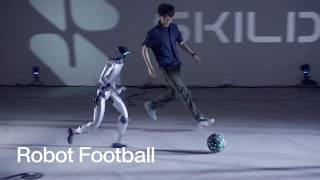
This robot learned football by playing itself for 140 years
Skild · 2026-09-24 · officialDescription by Gemini, which watched the video:
Summary
This video, published by Skild AI, demonstrates a humanoid robot playing 1v1 soccer against human opponents in real time. Powered by Skild AI's foundation model (Skild S1 / Skild Brain) trained via simulated self-play, the robot autonomously dribbles, intercepts, defends, and scores goals.
What is shown
- [00:00 - 00:34]: A bipedal humanoid robot marked "autonomous 1x" actively playing soccer 1-on-1 against a human player in a testing arena with "SKILD AI" branding, dynamically tracking the ball, repositioning, and blocking.
- [00:11 - 00:14]: First-person and close-up views showing the robot's lower limbs dribbling, maneuvering around the ball, and defending against a human opponent.
- [00:35 - 00:49]: The humanoid playing on a marked green pitch with mini goal nets, successfully tackling the ball from a human player and kicking it cleanly into the goal.
- [00:50 - 00:55]: Engineers, researchers, and spectators watching in the room celebrating, filming on smartphones, cheering, and applauding the robot's performance, ending on the Skild AI logo.
Claims & numbers
- Autonomous operation: All gameplay clips are labeled with an on-screen indicator reading "autonomous 1x" denoting real-time autonomous operation.
- Training duration: The video title claims the robot "learned football by playing itself for 140 years" (via simulated self-play).
Notable quotes
- [00:46] (Audio commentary overlay): "What a goal! That is..."
- [00:51] (Spectator): "Whoa!"
- [00:53] (Spectator): "That's so sick."
Assessment
This is an official demonstration video from Skild AI highlighting real-world sim-to-real dynamic whole-body locomotion and ball manipulation. The footage is captured at real-time speed ("autonomous 1x") across multiple cuts, showcasing successful autonomous tackling and scoring against human defenders.
Described by gemini-3.8-flash on 2026-09-29 from the video's audio and frames.
Related posts (1)
- Skild AI: Physical Self-Play, S1 learns soccer Skild AI @SkildAI · x · 2026-09-23
Official announcement of self-play-trained humanoid soccer with sim-to-real transfer.
Related events
Sources (5)
- officialSkild AI: Physical Self-Play
- officialSkild AI on X
- pressHumanoids Daily: Skild AI S1 learns soccer through 140 years of simulated self-play
- pressInteresting Engineering: Skild AI's robot brain taught itself football
- videoSkild AI video: This robot learned football by playing itself for 140 years
id: 2026-09-23-skild-physical-self-play-soccer · updated 2026-09-29 · open in the interactive timeline