Testing AI chips to survive in space
Google · 2026-09-28 · official · 55,121 views
What's in the video
Description written by Gemini, which watched and listened to the whole video.
Summary
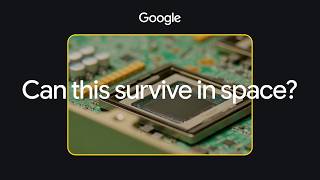
This mini-documentary from Google introduces Project Suncatcher, an initiative to operate AI data centers in space using solar power. Dr. Rishiraj Pravahan (AI Infrastructure Product Manager, Google) and Eric Stevens (Director of Systems Engineering, Planet) explain how commercial TPU hardware was tested for survival against rocket launch vibrations and ionizing space radiation.
What is shown
- Overview of Project Suncatcher [00:00 - 00:20]: Dr. Rishiraj Pravahan introduces the concept of scaling AI hardware in orbit.
- Launch Stress Simulation & Vibration Testing [00:21 - 01:18]: Rocket launch footage (NASA / ULA) followed by Planet's engineers mounting packaged hardware and a satellite payload on a three-axis vibration table [00:57 - 01:06], testing it under launch frequencies (whiteboard marked "M1 SunCatcher 7/8/2026" [01:03]).
- Radiation & Proton Beam Testing [01:59 - 02:37]: Engineers visit the Crocker Nuclear Laboratory (John A. Jungerman Hall) to bombard TPU boards with a proton beam while running active AI workloads and monitoring terminal outputs for bit flips [02:08 - 02:16].
- Detection of SDC [02:17 - 02:25]: Dr. Pravahan demonstrates logged output catching a Silent Data Corruption (SDC) event in real-time during radiation exposure.
Claims & numbers
- Dr. Pravahan states Project Suncatcher is Google's moonshot effort to scale AI data centers in space using available solar energy [00:01].
- Eric Stevens states that during a 10-minute rocket ride to low Earth orbit, spacecraft undergo sustained acceleration loads of up to 10× Earth's gravity (10 Gs) [00:33].
- Eric Stevens claims individual internal components like AI chips can experience amplified forces between 50 Gs to 100 Gs [00:39].
- Dr. Pravahan states the beam experiments evaluated whether TPUs could survive the radiation exposure equivalent to 5 years in orbit [02:27].
- Dr. Pravahan states that despite observing silent data corruptions (SDC), the TPUs "held up remarkably well" [02:38].
Notable quotes
- "Project Suncatcher is Google's moonshot effort to scale AI data centers in space, utilizing the free solar power available." — Dr. Rishiraj Pravahan [00:00]
- "The importance here is that we can leverage the advances in the commercial industry and immediately send those to space instead of waiting for long design cycles to make it space-rated." — Eric Stevens [02:41]
- "This is the first time we have found actually an SDC during a beam test." — Dr. Rishiraj Pravahan [02:22]
Assessment
This is an official engineering documentary produced by Google highlighting collaborative testing with Planet. It shows real laboratory test footage—specifically vibration table stress testing and proton beam radiation trials at UC Davis's Crocker Nuclear Laboratory—substantiating their claims about testing commercial TPUs for orbital environments.
Described by gemini-3.8-flash on 2026-09-29 from the video's audio and frames.