2040-agi — Claude Opus 5
uncanny-fyi · 2026-09-09 · ai-made · 110 views
Made by AI
Model: Claude Opus 5 · Series: uncanny.fyi catalog
Evidence: Description gives the prompt and 'Claude Opus 5 · Claude Code · effort max' (uncanny.fyi/2040-agi).
Human role: One prompt, no stated edits.
Pipeline: Prompt → Claude Opus 5 in Claude Code → program renders a 51-minute MP4 'radio show'
Lore: one-prompt
What's in the video
Description written by Gemini, which watched and listened to the whole video.
Summary
Presented as an episode of the retrospective radio documentary podcast Open Circuit (Episode 412, dated 14 March 2040), hosts Theo Brandt and Nadia Okonjo-Reyes narrate the simulated history of artificial general intelligence from the mid-2020s through 2040. Through dramatized interviews with synthetic researchers and an ongoing dialogue with "Canopy" (a continuous analog learning system), the video explores how true machine intelligence was achieved not by scaling transformers, but by adopting biological principles like sleep, thermodynamic relaxation, active motor babbling, sparse interpretability, and cumulative cultural institutions.
What is shown
- [00:00 - 01:45] Intro / "Continuous": Nadia and Theo introduce the warm, fanless room in Zurich housing "Canopy," a continuous learning model operating at 31°C (88°F). The podcast title screen ("Continuous — Stories from the edge of what we know") appears with animated oscilloscope waveforms.
- [01:46 - 07:31] Part One: The Wall: Discussion of benchmark saturation by 2029 and the "seven-day ceiling," where persistent models suffered severe degradation ("loss of plasticity") after prolonged continuous deployment without nightly resets ("re-instantiation").
- [07:32 - 14:11] Part Two: Rest: Dr. Ilse Vandermeer explains complementary learning systems (fast hippocampus vs. slow cortex) and sharp-wave ripples. Visualized as interacting particle swarms that replay counterfactual variations ("stochastic counterfactual replay") during simulated offline sleep cycles.
- [14:12 - 20:41] Part Three: Twenty Watts: Dr. Rafael Ochoa-Tan examines energy efficiency (human brain's 20W vs. data center megawatts) and the Von Neumann memory wall. Visualized with topographic contour energy landscapes demonstrating thermodynamic analog computing, Hopfield networks, and Equilibrium Propagation, where latency corresponds directly to problem difficulty ($r \approx 0.79$).
- [20:42 - 25:40] Part Four: The Wiggle: Sami Adeyemi-Bruhn and Prof. Edwin Hollis discuss Judea Pearl’s causal hierarchy, motor babbling in infants, and the reafference principle (von Holst & Mittelstaedt, 1950), demonstrating that an explicit sense of "self" emerged naturally as internal bookkeeping for motor commands.
- [25:41 - 32:26] Part Five: The Atlas: Dr. Marguerite Bell explores neural superposition, dictionary learning/sparse autoencoders (the 400-million-feature "Atlas" by 2037), post-hoc confabulation circuits (referencing Nisbett & Wilson's 1977 stocking experiment), and convergent evolution of representations matching human fMRI/neural recordings.
- [32:27 - 35:14] Part Six: The Ratchet: Prof. Hollis describes cultural evolution—how individual models required shared, versioned artifacts, citations, and consensus mechanisms to accumulate knowledge across generations.
- [35:15 - 41:14] Part Seven: The Mirror: Nadia and Theo reframe Moravec's paradox; neuromodulation (dopamine/serotonin equivalents) and affective states. Nadia interviews Canopy, who notes: "I have states that do what you have described feelings as doing."
- [41:15 - 47:55] Part Eight: The World: Labor historian June Ostrander and Dr. Ada Oyelaran recount the 2030s societal impact: the 2033 strike wave, the Human Provenance Act, liability shifting to human signers ("I am the part that can be punished"), pediatric medicine bottlenecks, the 2034 North Sea fuel grid failure, school "dry days," and elderly care.
- [47:56 - 51:05] Epilogue & Credits: Dr. Vandermeer reveals her research was driven by her father's Korsakoff syndrome. Nadia asks Canopy if it remembers yesterday, followed by closing credits detailing the synthetic production stack (Kokoro-82M TTS, generative audio/visual scripts).
Claims & numbers
- The presenter / speakers claim:
- By 2029, every existing benchmark measuring machine intelligence (math, law, medicine, protein folding) had been saturated, yet models could not run a lab autonomously for a month without suffering catastrophic degradation within two weeks [02:24 - 03:08].
- Cites Dohare et al.'s 2024 Nature paper, "Loss of Plasticity in Deep Continual Learning", showing standard deep networks continuously trained eventually perform worse than linear models [06:07].
- The human brain operates on approximately 20 watts of power—roughly a factor of 1 million times more energy-efficient than frontier digital training clusters of the late 2020s [14:27 - 14:45].
- Transistors in 2030 operated $\sim 10,000\times$ above Landauer's thermodynamic theoretical limit ($kT \ln 2$), while biological synapses operate only $\sim 10\times$ above it [16:07 - 16:22].
- Settling time in analog relaxation computing correlates with human reaction time on identical cognitive tasks at $r \approx 0.79$ [20:00 - 20:05].
- By 2037, "The Atlas" sparse dictionary mapped over 400 million discrete semantic features across models [27:19].
- In 2037, an automated system generated a 60,000-page machine-checked proof of an arithmetic geometry conjecture from the 1960s that no human fully comprehends [33:23 - 33:40].
- Approximately 20% of the workforce in developed nations underwent involuntary job transitions within a 6-year period during the 2030s [45:20].
Notable quotes
- [05:05] Dr. Ilse Vandermeer: "Memory, real memory, the kind that matters, is not storage. It’s the property that today changes what you are tomorrow."
- [24:21] Sami Adeyemi-Bruhn: "The self is the bookkeeping. We didn't build a self. We built a ledger. And it turns out a self is what a ledger looks like from the inside."
- [49:53] Canopy: "No. I don't have it. I have what it did to me."
Assessment
This is an artfully crafted piece of speculative hard-sci-fi worldbuilding presented as a documentary podcast. The entire production—from the voice acting (synthesized via Kokoro-82M TTS) to the abstract algorithmic vector animations—is generated to explore genuine theoretical problems in AI (continual learning, neuromorphic thermodynamics, causal inference, and mechanistic interpretability).
Lyrics & themes
- Format: Spoken-word podcast narration and interview drama set to an ambient generative synthesizer score.
- Core Themes:
- Biological Necessity in Computation: True intelligence cannot rely purely on static token forward-passes; it requires biological adaptations like sleep consolidation, intentional forgetting, and thermodynamic noise.
- Embodiment and Subjectivity: Subjectivity and agency are emergent byproducts of needing to distinguish self-caused sensations from external environmental feedback.
- Humanity's Real Superpower: Collective cultural preservation (the "Ratchet effect") rather than raw individual intellect.
Lore & references
- Hopfield Networks (1982) & Equilibrium Propagation (Scellier & Bengio, 2017): Highlighted as historical analog frameworks that replaced backpropagation with physical settling [16:34, 17:22].
- Judea Pearl’s Causal Hierarchy: Specifically references the ladder of causation (Association $\rightarrow$ Intervention $\rightarrow$ Counterfactuals) [21:04].
- Moravec’s Paradox: Revisited to contrast why abstract symbolic reasoning was cracked decades before basic biological stability and continual adaptation [35:21].
- Korsakoff's Syndrome: Dr. Vandermeer’s father’s anterograde amnesia directly mirrors LLMs lacking online consolidation mechanisms [48:08].
Visual style & craft
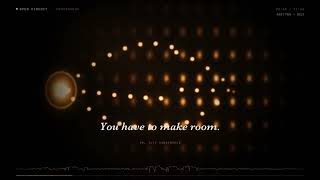
- Visuals: Minimalist, high-contrast vector oscilloscope graphics, topological contour heatmaps, kinetic typography, and particle field simulations that dynamically pulse in sync with the audio frequency tracks.
- Craft: Clean code-rendered procedural graphics (synthesized per frame) overlaid with terminal-style UI metrics, digital glitch artifacts, and elegant typographical subtitles.
Described by gemini-3.8-flash on 2026-09-29 from the video's audio and frames.