Claude agents discover a novel CRISPR-like enzyme system; Anthropic reveals its own biology wet lab
On September 23, 2026 Anthropic reported that about 950 Claude agents, running for 21 hours on 210 million tokens over a large DNA-sequence database, found array-associated reverse transcriptases (ARTs). These are a previously unknown enzyme system in bacteriophages with CRISPR-like repeat arrays. It is the first result from Anthropic's new molecular biology research group and Bay Area wet lab, which the company confirmed on Sept 18.
Key facts
- Announced Sept 23, 2026; technical preprint released
- ~950 Claude agents, 21 hours, 210M tokens
- 200,000+ reverse transcriptases gathered, 3,500 candidate systems, top 20 analyzed
- CRISPR pioneer Feng Zhang (MIT): 'an exciting example of how AI agents can contribute to biological discovery'
- Anthropic's wet lab (BSL-1/BSL-2, no human pathogens, all bench work by human scientists) confirmed Sept 18 by head of life sciences Eric Kauderer-Abrams
- Disputed novelty/significance: biologist Lucas Harrington: 'finding a weird cluster of genes and repeats is often the easy part... the hard part is figuring out what the system actually does'
- Mario Rodríguez Mestre (Univ. of Copenhagen) says his team had already found the pattern and suspects it leaked from his own Claude conversations; Anthropic denies this (says Claude is not trained on user transcripts and its biology team had no access to them). Mestre's group calls the system "jumbotrons", first seen in jumbo phages in 2022, still unpublished (NYT 2026-09-27)
Science result
- Field
- biology / microbiology / genome mining
- Problem
- Discovering new bacterial/phage defence and genome-editing enzyme systems
- Result
- Identified 'array-associated reverse transcriptases' (ARTs): phage reverse transcriptases adjacent to long CRISPR-like repeat arrays, from 200,000+ reverse transcriptases and 3,500 candidate systems; biological function still unknown.
- AI system
- Claude (≈950 parallel agents)
- Human role
- Humans wrote the initial prompt and ran all wet-lab work; agents did the search and analysis
- Verification
- Company preprint; experiments ongoing; not peer-reviewed
- Status
- disputed
- Why surprising
- Scale of the search (950 agents, 21 hours) and an endorsement from CRISPR pioneer Feng Zhang — but critics said finding such clusters is 'the easy part'.
What happened
Anthropic formed the life-sciences research group in spring 2026 to test whether general-purpose models can speed up biological discovery. The announcement does not say which Claude model version the agents used.
Why it matters
It is an example of massively parallel agent search yielding a biologically novel finding endorsed by a leading domain expert. It also marks Anthropic's move into running its own physical experiments.
Changelog
- 2026-09-29: created
- 2026-09-29: added science block and the Harrington / Rodríguez Mestre dispute (MIT Technology Review, 2026-09-28); (science & math tab)
- 2026-09-29: added post link(s) (2) from Anthropic posts cluster
- 2026-09-29: added Irish Times/NYT and Benzinga links and 'jumbotron' details of the Rodríguez Mestre priority claim; no Mestre preprint or own statement found yet
Videos (1)
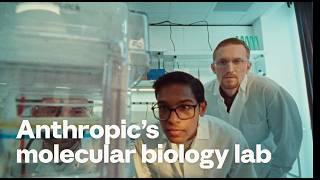
Inside Anthropic's molecular biology lab
Anthropic · 2026-09-23 · officialDescription by Gemini, which watched the video:
Summary — A promotional video from Anthropic spotlighting their in-house wet lab research initiative and the integration of Claude into life sciences discovery. Researchers describe the complexities of biological systems and discuss how Claude serves as a collaborative AI tool to accelerate research.
What is shown —
- [00:00 - 00:14] Scientists working in a laboratory setting; on-screen title card introduces Anthropic's research lab.
- [00:15 - 00:38] Standard biological lab procedures including pipetting, gel electrophoresis, buffer preparation, and centrifugation.
- [00:46 - 00:53] A computer interface featuring Claude analyzing protein structures, displaying a 3D visualization of Human Carbonic Anhydrase II complexed with Acetazolamide.
- [01:00 - 01:04] Scientists inspecting gel bands and collaborating across lab workstations.
- [01:09 - 01:11] A close-up of a monitor displaying disease target and biomarker analysis generated by Claude, with the model selector indicating "Opus 4.6".
- [01:12 - 01:16] Anthropic closing logo.
Claims & numbers —
- On-screen text states: "In Spring 2026, a team of scientists started a new research lab at Anthropic." [00:08]
- A researcher states regarding proteins: "We don't even know how half of them work." [00:17]
- A researcher claims Claude is an active collaborator that will "enable us to make far more discoveries than we were previously capable of." [00:51]
Notable quotes —
- [00:46] "Claude is essentially a collaborator in our scientific process."
- [00:51] "It's going to enable us to make far more discoveries than we were previously capable of."
- [00:56] "You have to let your expectations be completely obliterated by reality."
Assessment — This is an official institutional promotional video from Anthropic announcing their biology lab initiative. It showcases real laboratory environments and Claude UI interfaces (specifically showing Opus 4.6), but serves as a narrative overview rather than a detailed technical demo or benchmark validation.
Described by gemini-3.8-flash on 2026-09-29 from the video's audio and frames.
Related posts (4)
- Mario Rodríguez Mestre disputes Claude's enzyme 'discovery' (jumbotrons) Mario Rodríguez Mestre · other · 2026-09-27
The first high-profile priority dispute over an AI-lab 'discovery', raising the question of whether user conversations can leak into a lab's research claims. - Anthropic: Claude discovers a previously unknown CRISPR-like enzyme system Anthropic @AnthropicAI · x · 2026-09-23
Announces the first result from Anthropic's biology lab, a claim of AI-led discovery that was then publicly disputed. - Lucas Harrington: the Anthropic enzyme find is routine genome mining; the hard part is function Lucas Harrington @CRISPR_LuCas · x · 2026-09-23
The most-cited expert pushback on Anthropic's claim of an AI-made biological discovery. - Anthropic launches research preview of the Model Hardware Standard (MHS) Anthropic @AnthropicAI · x · 2026-08-27
A proposed standard for AI agents to safely operate physical lab and manufacturing equipment, a precursor to Anthropic's wet-lab work.
Related events
- Anthropic previews the Model Hardware Standard for AI agents operating lab equipment ★★★
- Anthropic launches Claude Science, an AI workbench for researchers (beta) ★★★
- FT: Google DeepMind has broken up its Nobel-winning AlphaFold team; Jumper, Adler and Pritzel now at Anthropic ★★★
Sources (12)
- officialClaude discovers a novel enzyme system with CRISPR-like repeats (Anthropic)
- paperTechnical preprint (PDF)
- pressTechCrunch: Anthropic says its biology lab has already found something big
- pressTechCrunch: Anthropic is operating a lab that conducts biology experiments
- pressSiliconANGLE: Anthropic opens AI-powered biology research lab
- pressPhys.org: Anthropic touts AI-led biology discovery
- discussionMIT Technology Review: When can we say AI made a scientific discovery?
- pressIrish Times (NYT syndication): Did Anthropic's AI really make a scientific discovery on its own? (Rodríguez Mestre 'jumbotron' priority claim)
- pressBenzinga: scientist says he had already studied the enzymes for 4 years
- videoInside Anthropic's molecular biology lab (video)
- officialAnthropic on X: Claude discovers an enzyme system
- discussionLucas Harrington on X: genome-mining critique thread
id: 2026-09-23-claude-discovers-novel-enzyme-system · updated 2026-09-29 · open in the interactive timeline